
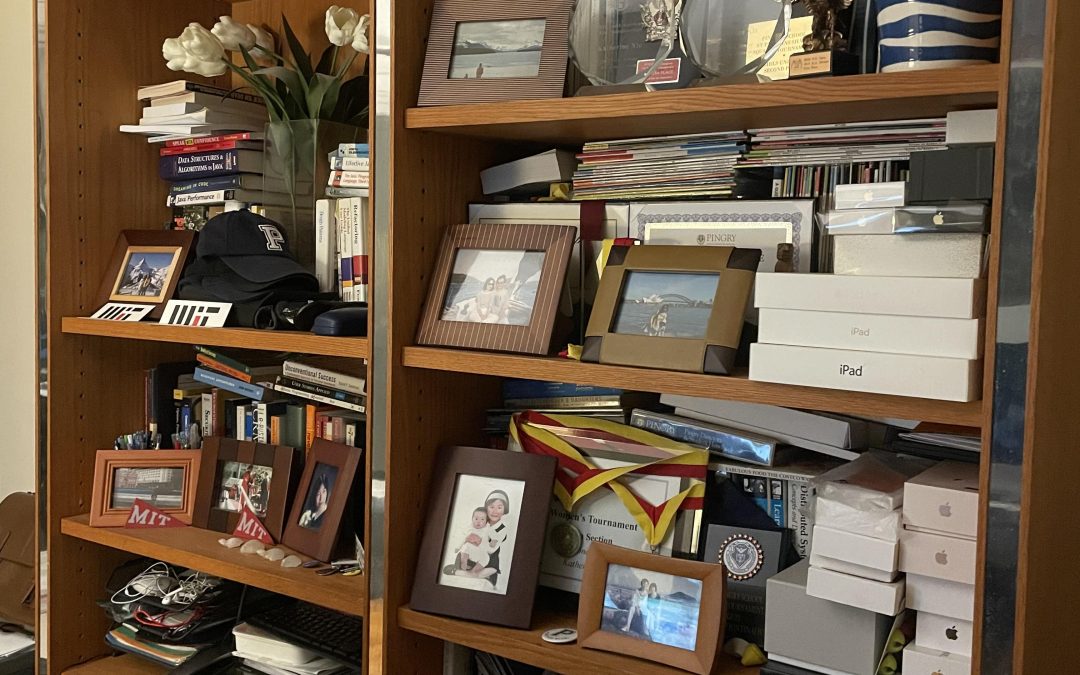
My dad has two monitors, two computers, an iPad, and an iPhone arranged on his black desk. Behind his desk is a large bookshelf packed with photos, and, of course, books: books on all sorts of programming languages, books on life and leadership, and books on computer science concepts. My dad is a student at heart, a hard-worker, and forever a computer scientist.
I always hear about my mom’s journey from China to America, and through it, I have heard of bits and pieces of my dad’s journey, but I have never asked him directly about it. Today, I went to his study to ask for an interview, and to finally piece together his story.
My dad immigrated from China to Canada with one suitcase and $500. He came to complete a PhD program in Computer Science in Canada, where he believed computer science had advanced further than in his home country. When he arrived, his university’s International Student Office arranged for him to stay for one week in a Canadian’s home. After that, he would have to find his own place to stay in. A week later, he was sharing an apartment with three other students. He became a teaching assistant part-time to earn money to pay for his tuition and living expenses. Later, he would meet my mom, who had also come from China for a better education.
Even though at first, it was difficult for my dad financially, he now reflects back and thinks that the hardest part about attending university in Canada was the culture shock. Once, he bought a cold sandwich for lunch, and when he took his first bite, he said that he “could not swallow it” because of the cheese and that “it was the texture that [he] could not get used to.” His first taste of cheese was among many more culture shocks that followed.
After completing his education in Canada, my mom and dad, who were already together, decided to move to the United States, where they thought there were better job opportunities. A few years later, they would have my sister, and later, me. Now, over two decades later, as I wrap up my interview with my dad in his study, he is sitting at his desk, and I am sitting on a small, white stool. I ask him about the hardest part about living in the US, and he says, almost hesitant, “I still feel like I’m not fully part of American society.” I know this sentiment is shared among many immigrants and refugees: how he does not quite feel that this place is home. I then ask him if he would want to live in China again. He looks up at the ceiling, thinking for a moment, and then says “I would not want go to live in China because it has changed so much. It would be foreign to me.” Perhaps there is a feeling of being in a sort of limbo between these two countries. He has lived in America for longer than he has in China, but he grew up in China. The fact that he has been away from his childhood home for so long causes him to question whether China could still be a home, and whether the place that he would return to would still be recognizable. In America, he must speak a second language and live in a place with a completely different culture, where not everyone is accepting of him. It’s difficult to call either place home.
I know that a lot of people may not see all of the effort he has put into creating a new life in America, but I know him to be an incredibly courageous, hard-working, and determined person, whom I’m proud to have as my father.
Recent Comments